

Fall brings simple materials children can pick up, squeeze, move, and arrange. Paper leaves, crayons, kitchen tongs, and cardboard are enough for most of these at-home ideas. Families in the UK can use the same autumn activities with familiar seasonal colors and materials.
Easy fall fine motor activities for preschoolers use familiar seasonal materials—paper leaves, apples, pumpkins, crayons, tongs, stickers, and dough—for small hand-and-finger movements such as pinching, grasping, transferring, tracing, threading, tearing, placing, and cutting. Use the chooser below to select by preferred action, approximate prep time, and the mess level that works for your family.
These activities are designed for ages 3–5, with practical adjustments through age 7. Treat the age ranges as flexible starting points, not tests. Offer one clear action, then stop when the activity is no longer enjoyable.
For more hands-on ideas you can adapt at home, explore the KidsColorsBook Activities hub.
Choose a Fall Fine-Motor Activity in Under a Minute
“Best fit” offers a simple starting point, not an age expectation. “Approx. prep” is an editorial setup estimate, not a guaranteed duration.
| Activity | Main hand action | Approx. prep | Mess | Best fit |
|---|---|---|---|---|
| 1. Tongs Leaf Color Sort | Pinch and transfer | 3 min | Low | A quick first choice |
| 2. Apple Pom-Pom Transfer | Grasp and place | 3 min | Low | Children who like filling containers |
| 3. Clothespin Leaf Match | Pinch and squeeze | 5 min | Low | A reusable table activity |
| 4. Pumpkin Sticker Patterns | Peel and place | 2 min | Very low | Minimal setup and cleanup |
| 5. Crayon Leaf Rubbings | Grasp and rub | 4 min | Low | A calm art-table option |
| 6. Fall Path Tracing | Trace and control | 3 min | Very low | Simple preschool pre-writing play |
| 7. Roll-and-Pinch Playdough Pumpkins | Squeeze and pinch | 2 min | Low–medium | Children who enjoy dough |
| 8. Torn-Paper Fall Tree | Tear and press | 5 min | Low–medium | A no-scissors collage |
| 9. Cardboard Leaf Lacing | Thread and pull | 8 min | Very low | More parent preparation, reusable result |
| 10. Apple Paper-Strip Weaving | Guide and pull | 8 min | Low | Children ready for two-step actions |
| 11. Fall Shape Pattern Strip | Pinch, rotate and place | 5 min | Very low | A quiet reusable task |
| 12. Build-a-Scarecrow Shape Puzzle | Grasp and position | 6 min | Very low | Children who enjoy simple puzzles |
| 13. Snip-and-Fringe Paper Leaves | Open, close and cut | 5 min | Low | Closely supervised tool practice |
| 14. Cut-and-Sort Fall Shapes | Cut, transfer and place | 5 min | Low | Cutting with a clear next step |
| 15. Hole-Punch Leaf Garland | Squeeze, thread and pull | 7 min | Low | An older or more supported challenge |
Quick Pinch, Place, and Transfer Activities
Begin here for low-prep fall fine motor activities for preschoolers. Keep loose pieces large and use a tray for quick cleanup.

1. Tongs Leaf Color Sort
What you need: Large paper or felt leaves in two or three colors, child-appropriate kitchen tongs, and matching cups or sections of a tray.
What to do: Mix the leaves. Use the tongs to move one leaf into the matching color area. Let it fall where it lands.
Fine-motor action: Pinching the tongs, maintaining a grasp, transferring and releasing.
Make it easier: Use fingers first, switch to easy-grip tongs, or offer only two large color groups.
Make it harder: Move the cups apart or create a repeating color pattern.
2. Apple Pom-Pom Transfer
What you need: Large red and green pom-poms, one bowl, a muffin tray or two wide cups, and tongs if wanted.
What to do: Call the pom-poms “apples” and move them into tray spaces one at a time, sorted by color or mixed.
Fine-motor action: Grasping, pinching, transferring and releasing into a target.
Make it easier: Use fingers and the largest soft pieces you have.
Make it harder: Add tongs or smaller target cups without turning the task into a race.
The CPSC small-parts guidance explains that certain small parts can pose choking, aspiration or ingestion hazards. Supervise loose craft pieces closely and use larger alternatives when small components are not appropriate for your child.
3. Clothespin Leaf Match
What you need: Cardboard leaves, clothespins or easy-opening clips, and two or three matching color marks.
What to do: Add matching color spots to leaves and clips. Squeeze one clip open, line it up, and release it around the edge.
Fine-motor action: Pinching, squeezing, aiming and placing.
Make it easier: Hold the cardboard steady or use clips that open with less pressure.
Make it harder: Add more colors or invite your child to place clips all around a large leaf.
Check each clip and stay nearby during use.
4. Pumpkin Sticker Patterns
What you need: A large paper pumpkin and large round stickers in two or three fall colors.
What to do: Draw a broad curved path. Place stickers along it, or cover the pumpkin freely if the path frustrates your child.
Fine-motor action: Peeling, pinching small edges, aiming and pressing.
Make it easier: Lift one corner of each sticker before handing over the sheet.
Make it harder: Start a simple two-color pattern for your child to continue.
Trace, Squeeze, and Tear Activities
These autumn fine-motor activities use paper, crayons, and dough in a contained table setup.
5. Crayon Leaf Rubbings
What you need: Clean, familiar leaves, plain paper, tape, and thick crayons with enough wrapper removed for the side of each crayon to touch the page.
What to do: Put a leaf vein-side up beneath taped paper. Rub the crayon’s side across the sheet until the shape appears.
Fine-motor action: Grasping, holding paper steady and making repeated controlled rubbing movements.
Make it easier: Use one large leaf and a short, thick crayon.
Make it harder: Overlap two leaf shapes or trace around the revealed outline afterward.
For art materials, follow the current age, use, and warning information on the label. CPSC guidance explains the U.S. labeling requirements for materials with identified hazards.
6. Fall Path Tracing
What you need: Paper, a thick crayon or marker, and a hand-drawn path between two seasonal pictures—for example, a leaf traveling to a basket or an apple to a tree.
What to do: Draw one wide path. Finger-trace it, then use a crayon from the starting picture to the destination.
Fine-motor action: Grasping a drawing tool, tracing and stopping at a visible endpoint.
Make it easier: Use a straight or gently curved path with plenty of space.
Make it harder: Add loops, corners or several short paths. Keep each one visually separate.
If you want a ready-to-print activity for another day, browse the Free Printables collection.
7. Roll-and-Pinch Playdough Pumpkins
What you need: Age-appropriate orange modeling dough, a work mat, and an optional broad dough tool for making grooves.
What to do: Squeeze and roll a ball, pinch the top for a stem, then press broad grooves with a finger or the dough tool.
Fine-motor action: Squeezing, rolling, pinching and manipulating with fingertips.
Make it easier: Work with one generous piece and make one large pumpkin.
Make it harder: Create several sizes, add flat dough leaves or arrange a small pumpkin patch.
Follow the dough label, supervise any accessories, and keep modeling dough clearly separate from food.

8. Torn-Paper Fall Tree
What you need: A sheet with a simple tree trunk, fall-colored paper, and age-appropriate glue.
What to do: Tear the colored paper into small leaf pieces, pinch and place them around the branches, then press each one onto a small dot of glue.
Fine-motor action: Starting and continuing a tear, pinching, placing and pressing.
Make it easier: Begin a few tears at the paper edge or offer larger ready-torn pieces.
Make it harder: Tear smaller leaves and plan where different colors will go before gluing.
Thread, Weave, Place, and Build Activities
These reusable cardboard and paper activities need a little more parent preparation. Each asks children to guide one item through or onto another.
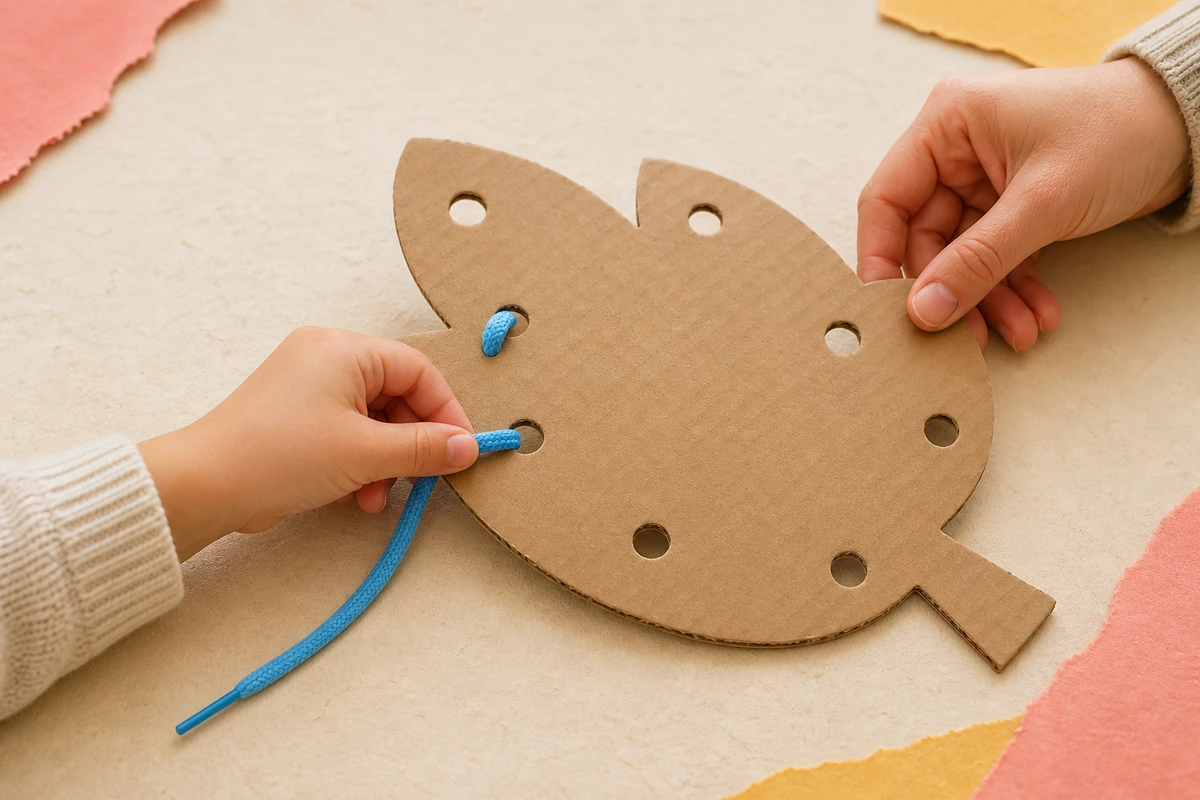
9. Cardboard Leaf Lacing
What you need: A large cardboard leaf with widely spaced punched holes and a short, thick lace with a firm tip.
What to do: Secure one end. Guide the lace through a hole, turn the leaf and pull it through the next.
Fine-motor action: Threading, grasping, pulling and using both hands together.
Make it easier: Use fewer, larger holes and start the first pass.
Make it harder: Follow the holes in order or use two colors on separate short laces.
Use a short lace for the activity, stay beside your child while it is in use, and store it afterward.
10. Apple Paper-Strip Weaving
What you need: A large paper apple with adult-cut vertical slots and several wide paper strips.
What to do: Start one strip, guide it over and under the apple sections, then pull both ends even.
Fine-motor action: Guiding, threading, pulling and repositioning paper.
Make it easier: Cut very wide slots, use stiff paper and begin each strip for the child.
Make it harder: Offer narrower strips or invite an alternating two-color arrangement.
Prepare the slits yourself unless cutting is part of the supervised plan.
11. Fall Shape Pattern Strip
What you need: Large paper leaves, apples and pumpkins, plus a long strip of cardboard and reusable putty or a small amount of glue.
What to do: Begin a leaf–apple pattern. Your child pinches, turns and places the next shape.
Fine-motor action: Pinching, rotating, aligning and pressing pieces into position.
Make it easier: Use two very different large shapes and show the complete pattern beside the blank strip.
Make it harder: Use three shapes or let your child design a pattern for you to copy.
12. Build-a-Scarecrow Shape Puzzle
What you need: Large pre-cut paper or felt shapes: a face, hat, body, arms and legs. A simple outline is optional.
What to do: Build the scarecrow from the center outward. Leave pieces loose or press them onto reusable putty.
Fine-motor action: Grasping, rotating, positioning and pressing.
Make it easier: Offer four large pieces on top of a clear outline.
Make it harder: Add clothing details or remove the guide so your child plans the arrangement.
Keep every loose shape large enough for your chosen setup, especially when younger siblings are nearby.
Cut, Punch, and Assemble Activities
This group uses tools or cords. Choose each tool according to the manufacturer’s age and use instructions. Stay close, and prepare cutting or punching steps yourself when a tool is not appropriate for your child. Alder Hey’s fine-motor activity guidance also places scissors practice under supervision.
13. Snip-and-Fringe Paper Leaves
What you need: Large paper leaf shapes, short guide lines around the edges, and child-appropriate scissors used according to their instructions.
What to do: Make one short snip toward a guide line, stop, then turn the leaf and repeat around part of the edge.
Fine-motor action: Grasping scissors, opening and closing them, stopping and rotating paper.
Make it easier: Hold the paper steady or prepare a sturdy strip with widely spaced straight lines.
Make it harder: Ask the child to rotate the leaf independently and stop at each marked endpoint.
14. Cut-and-Sort Fall Shapes
What you need: Wide paper strips with one large leaf, apple, or pumpkin in each section, child-appropriate scissors used according to their instructions, and a sorting tray.
What to do: Cut between pictures on short straight lines, then move each shape to its matching tray section.
Fine-motor action: Opening and closing scissors, grasping, transferring and placing.
Make it easier: Pre-cut the shapes so the child completes only the sorting and placing steps.
Make it harder: Add more cut lines or arrange the finished shapes into a repeating sequence.
15. Hole-Punch Leaf Garland
What you need: Large paper leaves, a single-hole punch appropriate for your child and setup, and a short, thick lace or ribbon.
What to do: Punch one hole per leaf and thread two or three onto the lace. Store the short garland with its cord afterward.
Fine-motor action: Squeezing the punch, threading, pulling and repositioning.
Make it easier: An adult punches the holes while the child threads a few large leaves.
Make it harder: Let the child operate the punch with support if its instructions allow, or arrange the leaves in a color sequence before threading.
Stay within reach and follow the hole punch instructions.
Adjust the Same Activity for Ages 3 to 7
Children of the same age can prefer different tools and textures. Use this matrix to adjust the activity in front of you rather than treating the age ranges as milestones.
| Starting point | Parent setup | Child action | Useful adjustment |
|---|---|---|---|
| Around age 3 or new to the action | Prepare large pieces, wide targets and the first step | Finger transfer, one clip, one trace or one short thread | Reduce choices and finish after a few successful turns |
| Ages 4–5 or comfortable with the action | Set out the standard activity with a clear example | Use tongs, continue a short pattern, lace several holes or make short snips | Add one extra step, not several at once |
| Ages 6–7 or asking for more challenge | Offer smaller targets or a longer sequence | Plan patterns, weave independently, rotate paper or combine two actions | Increase precision while keeping the same seasonal materials |
If a tool creates frustration, move back to fingers, larger pieces or a shorter sequence. That keeps the activity usable without turning it into a test.
Use What You Have: Simple Material Swaps
- No pom-poms: Crumple paper into large soft “apples,” or cut large circles from scrap paper. Avoid tiny beads or hard food pieces as a casual substitute.
- No tongs: Try easy-grip kitchen tongs, a large salad server used with two hands, or finger transfer.
- No craft leaves: Cut broad leaf shapes from cereal-box card, packaging paper or felt.
- No playdough: Use another age-appropriate modeling dough according to its label. If making dough at home, check ingredients for your household before use and supervise it as a craft material.
- No clothespins: Use easy-opening bag clips that are clean, intact and comfortable for the child to squeeze.
- No hole punch: Prepare holes yourself with the child away from the tool, then offer only the lacing step.
For more printable activities with a learning focus, explore the KidsColorsBook learning activities collection.
More Activities and Printables from KidsColorsBook
For a broader mix of at-home ideas beyond fall fine-motor play, see our screen-free activities for preschoolers.
If your family wants a gentle late-October theme, continue with these not-too-spooky Halloween activities for preschoolers.
Frequently Asked Questions
What counts as a fine-motor activity for a preschooler?
For this guide, a fine-motor activity is one in which the child uses small, deliberate hand and finger actions: pinching a clip, grasping tongs, tracing a line, threading a lace, tearing paper, or placing a shape. The seasonal theme supplies the materials; the hand action keeps the activity focused.
Which activity is easiest for a younger preschooler?
Start with Tongs Leaf Color Sort using fingers instead of tongs, Pumpkin Sticker Patterns with a sticker edge already lifted, or a large-piece Fall Shape Pattern Strip. Offer only a few pieces and one simple direction. If the child wants to repeat the same action, there is no need to add difficulty.
Which choices create the least mess?
Pumpkin Sticker Patterns, Cardboard Leaf Lacing, Clothespin Leaf Match and Build-a-Scarecrow Shape Puzzle create very little cleanup. Put the pieces on a shallow tray before you begin, and keep glue, dough and outdoor leaves for a day when a little more cleanup is manageable.
What can I use when I do not have the listed craft materials?
Paper, thin cardboard, crayons, kitchen tongs, and clean reusable clips cover most of the list. Change the object without changing the action: paper balls can replace pom-poms, cardboard can replace felt, and finger transfer can replace tongs. Keep substitutes large, intact, and appropriate for supervised use.
How can I adapt these activities for an older child?
Keep the same fall materials but add precision or sequencing. An older child might plan a three-shape pattern, weave narrower strips, trace a more complex path, rotate paper while cutting or design a leaf color sequence before lacing. Add one meaningful challenge while leaving the core activity easy to understand.
Pick One Small-Hand Action to Try
You do not need to prepare all 15 activities. Choose one that matches the time, materials, and cleanup you have today. A few paper leaves and one clear action—pinch, trace, tear, thread, or place—are enough to bring a practical fall fine-motor moment to the kitchen table.


2 notes from other parents