
To pack a preschool travel activity kit, start with one easy-to-open pouch, a small drawing pad, a few familiar crayons and one picture book. Add a folder for loose pages only if you need it. Try the kit at home, take out one activity at a time, and put everything back in the same place after each outing.
A useful kit is one you can open while sitting beside your child and close when it is time to leave. You do not need a new toy for every ten minutes or a bag full of tiny activities. Start with materials your child already enjoys, then change the contents after you see what gets used.
This guide is for parents of children around ages 3–7, with preschoolers at its centre. Use the kit during stationary waits, at a family visit or at a suitable table. It is not a setup for playing in a moving car. Choose materials for your child and stay nearby to help.
Start with the space where you will open it
Before you choose activities, picture the waiting space. Will there be a table? Will you need to stand up quickly? Can your child keep a pad on their lap comfortably? Those answers matter more than how many items fit in the bag.
| Where you will use it | Start with | Leave out |
|---|---|---|
| Waiting room with no table | A small picture book or a drawing pad your child can manage | Loose game pieces and activities needing a wide surface |
| Family visit with a clear table | Paper, crayons and a few chosen coloring pages | The whole printable collection |
| Short stop where you may leave suddenly | One book to look through together | Anything requiring assembly or drying time |
| A longer stationary wait with space to draw | A pad, crayons and a second familiar activity kept in reserve | Several open activities at once |
If there is no suitable place to open the kit, keep it closed. Look through the book together or talk about what you can see. The bag is an option, not a promise that every wait will become activity time.
Choose a container your child can help use
Try a pouch or small bag you already own before buying storage. Check the opening with your child: can they see what is inside, reach one item and help put it back? A deep bag that swallows everything may be less useful than a simple wide opening.
Keep drawing tools in their own small case. Put a pad beside that case and the picture book behind it. If you take loose sheets, use a slim folder that fits the bag without curling the corners. A folder can be the entire kit for a family visit if it holds the pages and your separate crayon case travels beside it.
Use the same places each time. You might say, “The crayons go in this case, and your book slides in here.” That gives you a shared packing plan without turning cleanup into a test.
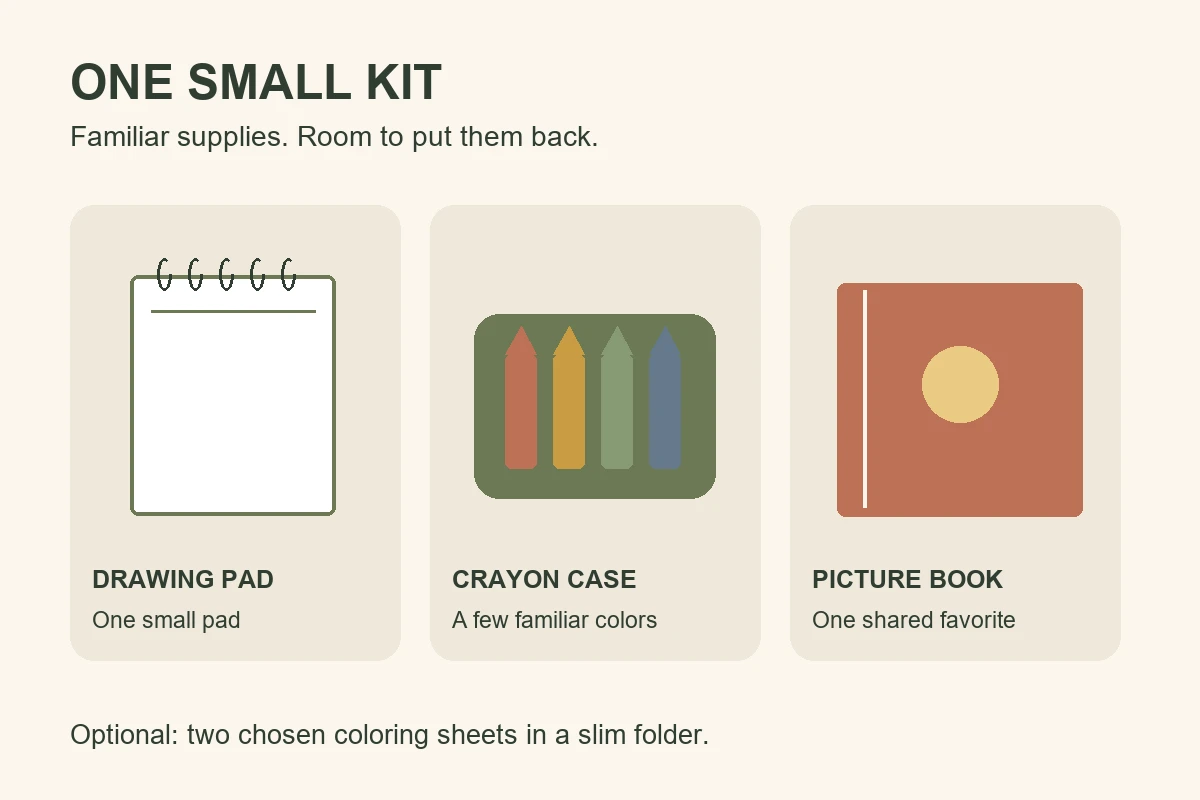
A small worked kit to try first
Here is an example, not a required shopping list. Adapt the quantities to your bag and child:
- One small drawing pad for open-ended marks, pictures or adult-drawn prompts.
- Four familiar crayons in a case that closes securely.
- One thin picture book you can enjoy together.
- Two optional coloring sheets in a folder, if there is room and a suitable drawing surface.
Choose children’s art materials and follow their age guidance and warnings. Keep the packaging information so you can check it later. The CPSC Art and Craft Safety Guide gives parents guidance on selecting and supervising art materials. Do not add small loose pieces for a child who mouths objects.
For this starter kit, skip scissors, glue, glitter, paint and activities with lots of counters. They add preparation or cleanup that the example does not need. If a favourite activity requires those supplies, save it for a place where you can set it up properly.
Lay the contents beside the open bag once. If you cannot put them away comfortably, remove something. A kit that closes easily is more useful than one that only works when an adult packs it perfectly.
Add printable pages without packing a whole book
Ask your child to choose between two pages before the outing. Keep the spare behind the first page in a folder. You can also take blank paper: a printable is optional, and you do not need to finish a picture before putting it away.
If the page is too big for your kit, use a larger folder or leave that page for a table at your destination. Avoid shrinking a detailed activity just to make it fit. For paper-size and scaling questions, use our guide to printing coloring pages on A4 and US Letter.
If you already use KCB printables, Cute Animals Adventures – 19 Printable Coloring Pages is one optional source of animal pictures. It is a digital PDF for ages 3–7 in US Letter format; print just the pages you want to bring. It does not include a pouch, crayons or a physical book.
For other options, browse the free printables before buying anything. If you are deciding which kind of page suits your child, our printable activity book chooser can help with that separate decision.
Do a short practice run before you leave
Sit together in a space similar to the one you expect to use. Open the bag, choose one activity and try putting it away again. You are checking the setup, not measuring how long your child stays occupied.
Notice what needs your help. A stiff zip may mean you open the pouch. Crayons rolling away may mean the case stays open beside the pad. A folder that is difficult to handle may be better replaced with the pad alone.
Practise the leaving moment too: “We need to go. Shall we save this picture in the folder?” Keep an unfinished drawing if your child wants it. You can return to it another day.
Open one activity and keep the rest packed
When there is a suitable place to sit, offer a small choice: “Would you like your book or your drawing pad?” Keep the other option inside the bag. Join in if your child wants company; this is not a kit designed to guarantee independent play.
If the first activity loses its appeal, put it away before offering the next. You might look for a favourite picture together, draw a silly shape for your child to change, or simply pause. For more ideas to choose from at home, see our screen-free activities.
When the appointment starts, food arrives or it is time to move, close the kit. It is fine to stop midway through a page. Choose the moment and setting that work for the family rather than trying to use everything you packed.

Reset the kit after the outing
Open the bag at home before storing it. Return crayons to their case, check that the pad and book are still usable, and separate fresh pages from drawings your child wants to keep. Follow the materials’ instructions for cleaning.
Replace only what was used up or no longer works. If the book was a favourite, leave it in. If neither coloring page came out, take one out next time instead of adding three new choices.
A simple reset note can be enough: “Add paper.” Keep any larger collection of printables at home. The travel kit holds a small selection for an outing; it does not need to become your family’s paper-storage system.
When the kit is not working
| What you notice | What to change next time |
|---|---|
| Everything gets tipped out | Pack fewer items and help take out one choice. |
| Pages bend or slip around | Use a pad, choose a folder that fits, or keep drawing for a table. |
| Your child only wants your company | Read or draw together. The kit does not have to mean playing alone. |
| Nothing interests them | Put it away. Try a different familiar option on another outing. |
| Packing up is difficult | Remove the fiddliest item and leave more room in the container. |
Questions parents ask
How many activities should I pack?
Start with a drawing option and a picture book, then add one spare only if useful. These are starting suggestions, not a rule for every child or journey.
Do I need to buy a travel activity kit?
No. Try a bag, pad and familiar materials you already have. Check how they fit and whether the kit is easy to use before deciding you need different storage.
Can I use the same kit for two children?
You can share a container, but consider a separate pad or page for each child. Choose materials suitable for both and help with shared supplies. If sharing makes the wait harder, keep their drawing options separate.
Does reusable mean every page must wipe clean?
No. Here, reusable means keeping the bag and suitable supplies for future outings while replacing paper when needed. Laminating and dry-erase materials are not required.
What if my child does not use it?
That is useful information for the next outing. Keep a favourite, remove an unused item or leave the kit at home when it does not fit the plan. There is no need to turn the wait into a lesson.


