Printable activity books can be wonderfully convenient, but the biggest pack is not always the most useful one. The right choice fits what your child enjoys now, the setting where you will use it, and how much help you can realistically give.
Choose printable activity books for kids by matching four things: your child’s current comfort with the page, the activity type they willingly return to, the moment you need to fill, and the amount of adult help available. Print a small test set before the whole book. A good pack should feel inviting on the first page, not like a stack your family has to finish.
Age labels are useful starting points, not promises about what every child should do. A three-year-old may love a simple maze and ignore coloring; a six-year-old may still prefer bold, open pictures. Watch the page in use and adjust from there.
If you want to compare a few individual pages before choosing a larger pack, start in the KidsColorsBook Free Printables library.
Use This Quick Chooser First
Begin with the moment you are planning for. The activity mix matters more than a large page count.
| When you need it | Look for | Skip for now | Print first |
|---|---|---|---|
| Quiet time at home | Coloring, matching, simple mazes, drawing prompts | Pages that need constant explaining | Three different low-prep pages |
| Travel or a waiting room | Self-contained pages with few loose pieces | Cut-and-glue tasks or bulky supplies | Five pages plus a spare |
| A rainy afternoon | A mixed pack with short and longer choices | Twenty near-identical pages | One creative, one puzzle, one movement break idea |
| Party or classroom table | Clear instructions, repeatable games, answer keys where useful | One-copy-only activities for a group | One complete game before the event |
| Gentle learning practice | One skill per page, clear examples, generous working space | Dense worksheets with several new directions | Two pages at different difficulty levels |

Seven Things to Check Before You Print
1. Start with the purpose, not the page count
Ask what job the activity book needs to do. Is it a quiet option while dinner is prepared, a travel backup, a party game, or a small learning routine? That answer immediately narrows the useful page types.
For a ten-minute calm break, three appealing pages can be better than an 80-page bundle. For a school break or several siblings, a larger mix may make more sense. Count the pages your family is likely to use, not just the number printed on the cover.
For a wider set of ideas that do not require a printable, browse the Activities hub.
2. Match the page to current comfort, not only age
Look at the actual page. Are the spaces open enough? Is the route through the maze easy to see? Are there too many tiny details? Can the child understand the first step after one short explanation?
A useful starting page offers a little challenge without hiding what to do. If a child hesitates, simplify the choice: cover part of the page, circle the starting point, or switch to a bolder design. If the page is finished instantly and the child asks for more, offer a slightly busier version next time.
That observation is more reliable than assuming every child within one age band wants the same level of detail.
3. Choose an activity mix your child will actually use
A balanced printable activity book might combine coloring, matching, mazes, tracing, counting, spot-the-difference pages, drawing prompts, and a simple game. It does not need every type. Two or three familiar favorites plus one new format is often an easier place to begin.
Check for repetition, too. Ten coloring pages can be useful for a child who loves coloring. The same ten pages can feel repetitive to a child who wants a puzzle after one picture. A mixed pack is valuable only when the mix matches the user.
The Learning Activities collection and Coloring Pages collection make it easier to compare focused page types before you choose a mixed bundle.
4. Check how much adult help each page needs
Some pages are easy to start independently after a quick example. Others require an adult to read clues, cut pieces, explain rules, or manage glue and scissors. Neither kind is better; the important question is whether the help level fits the moment.
For a busy transition, choose pages with a visible starting point and one clear action. For shared time, a bingo game, scavenger hunt, or cut-and-build page can be worth the extra setup.
When art materials are involved, follow the product label and any warnings. The U.S. Consumer Product Safety Commission’s art-material guidance explains that art materials are assessed for chronic hazards and that required conformance or cautionary labeling belongs on the product or its packaging.
5. Verify the file and printing details
Before buying or downloading, look for the file format, page size, orientation, and whether the pages are color or black-and-white. A PDF is usually the simplest format for keeping the layout stable. US Letter pages are designed for 8.5 × 11 inch paper; families using A4 should check the preview and printer settings before running the full book.
Also check whether the download is one PDF or a ZIP folder with several files. A bundle may include separate books, instructions, and answer keys. Knowing that before printing prevents a rushed “print all” click.
Use the printer’s preview screen. Confirm that the page is centered, nothing important is cut off, and the scale matches the creator’s directions. Print one page before using a high-quality or color setting for the rest.
6. Look for instructions, answer keys, and a clear license
Instructions matter most for games, cut-and-assemble tasks, and pages with more than one possible interpretation. Answer keys are helpful for mazes, word searches, crosswords, and learning pages when an adult wants a quick check.
Read the use license as well. Personal-use files may allow printing for your household but not sharing the PDF. Classroom terms can be different. A clear license tells you what may be printed, copied, or reused without guessing.
Keep the original download in one named folder and print from that file. This makes it easier to find the instructions again and avoids sending the source file where the license does not allow it.
7. Run a small trial before committing to the full book
Choose three to five pages that represent the pack: one easy-looking favorite, one page at the expected level, one slightly different activity, and perhaps a game or drawing prompt. Offer them across two or three short sessions.
Notice what happens without turning the trial into a test. Which page is chosen first? Where does help become necessary? Does the child ask for another similar page? Those answers show whether to print more, choose a different mix, or save the pack for later.
A small trial also reduces paper and ink waste. You can return to the PDF whenever the moment is right.
Age-by-Age Starting Points Without Turning Age into a Rule
Use these as flexible page-design starting points. Move up or down according to the child’s interest, experience, and willingness to continue.
| Starting point | Page traits to try | Adult setup | Signs to adjust |
|---|---|---|---|
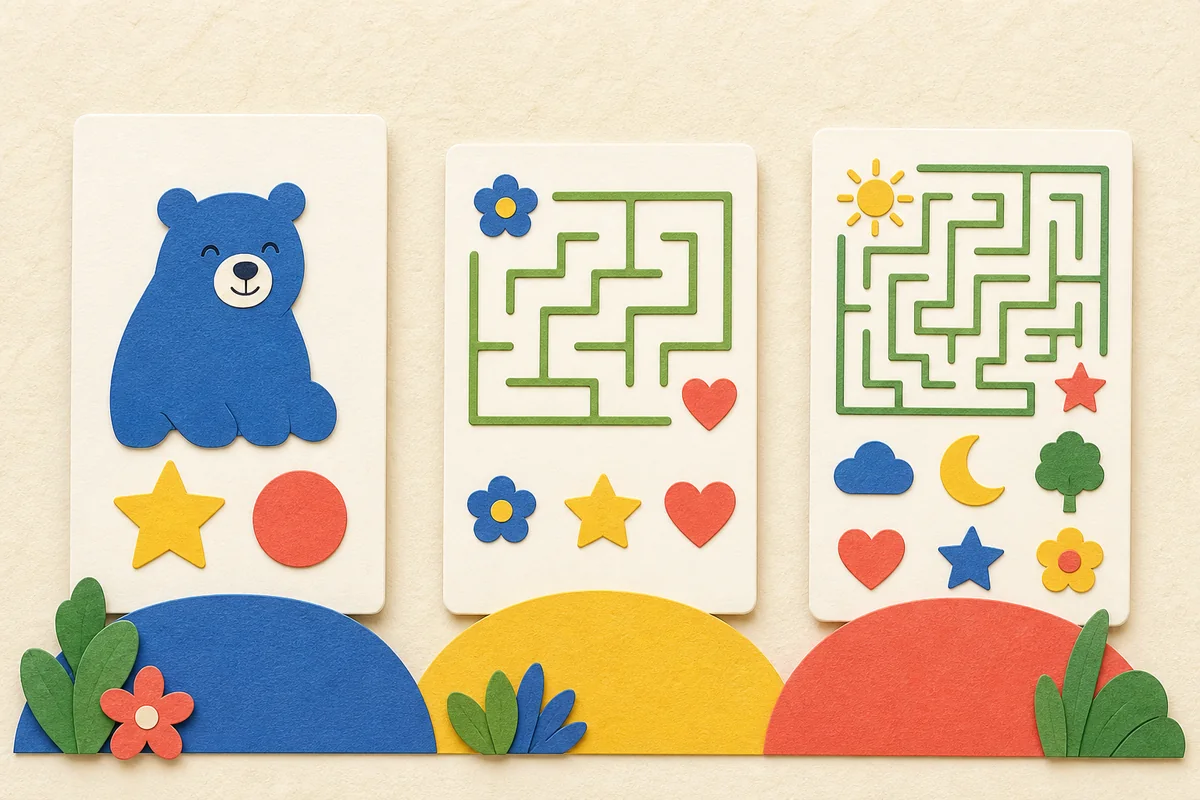
| Ages 3–4 or new to printables | Bold pictures, wide paths, large matching choices, one action per page | Show the first step and offer one or two pages | Switch if the child cannot see where to begin or loses interest quickly |
| Ages 4–5 or familiar with simple pages | Short mazes, two-step matching, simple tracing, open coloring scenes | Read the direction once and stay available | Add space or simplify if the page becomes crowded |
| Ages 5–7 or asking for more challenge | Longer mazes, word or number puzzles, drawing prompts, multi-step games | Check the rules, then let the child choose the order | Return to a simpler version when new rules overshadow the fun |
A child can enjoy pages from more than one row. The aim is a useful match today, not proof that a particular level has been reached.
The Five-Page Print Test
- Print one obvious favorite. Start with the theme or activity your child already chooses.
- Print one easy-entry page. It should have a clear start and a short finish.
- Print one representative page. Choose the type that appears most often in the pack.
- Print one stretch page. Add a slightly longer maze, a new puzzle, or a two-step direction.
- Print one open-ended page. A drawing prompt or broad coloring scene shows whether the child wants more creative freedom.
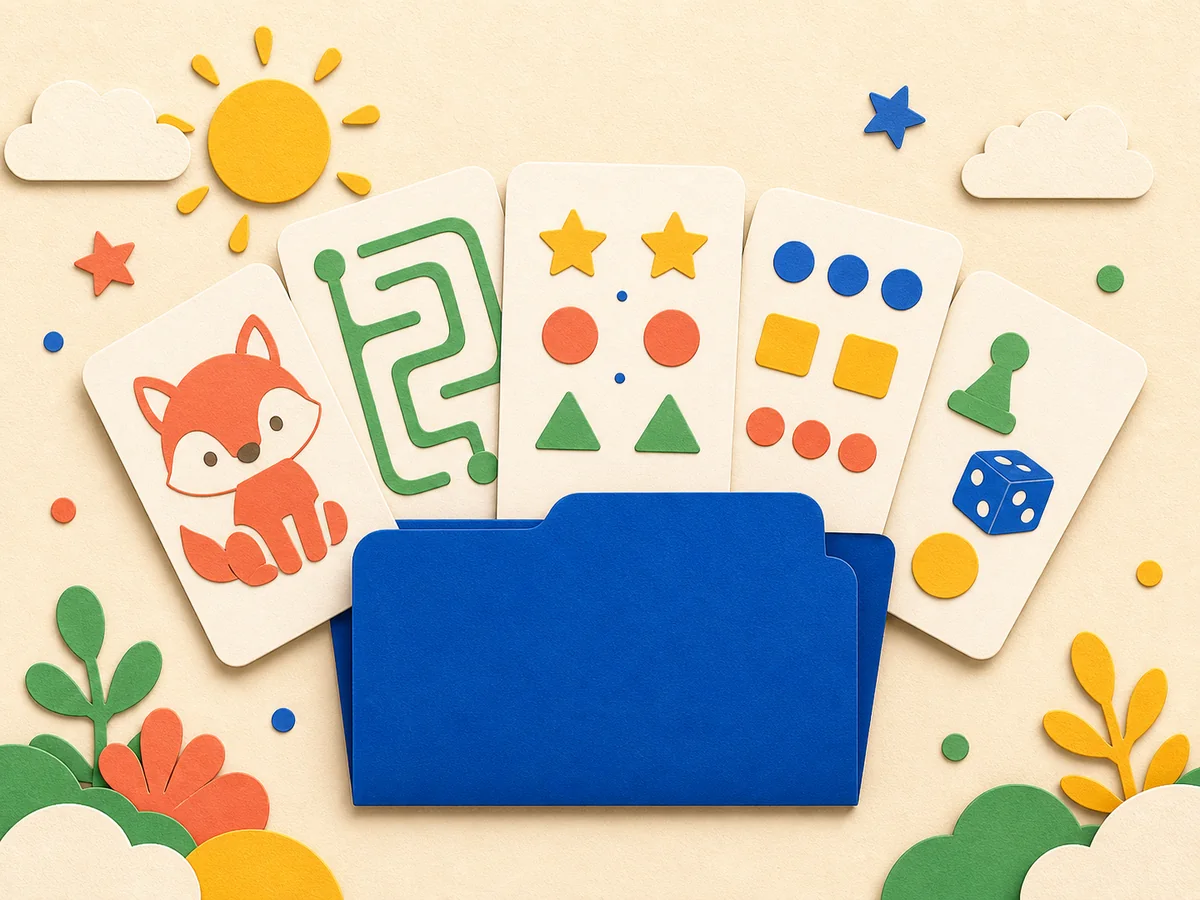
Put the five pages in a thin folder rather than stapling them immediately. Let the child choose the order. Afterward, print more of the types that were used and leave the rest digital.

Common Printable Activity-Book Mistakes
- Printing the whole file first: Test a representative set before spending paper and ink.
- Choosing only by age label: Check the page preview and the child’s current comfort.
- Buying variety that looks good but will not be used: Start with familiar favorites and add one new activity type.
- Ignoring setup: Separate easy independent pages from activities that need reading, cutting, or game pieces.
- Forgetting the license: Store and print the file according to its personal or classroom-use terms.
- Using every page as practice: Keep some choices purely playful, especially when the printable is meant for a break.
For a broader backup list that includes movement, pretend play, sensory ideas, and simple crafts, see these screen-free activities for preschoolers.
Frequently Asked Questions
Are printable activity books suitable for three-year-olds?
They can be when the pages have bold visuals, generous spaces, one clear action, and a short finish. Start with one or two pages and offer help with the first step. If the child would rather draw freely or move on, save the page for another day.
Should I print the whole activity book at once?
Usually, no. Print three to five representative pages first. If the format, scale, and activity mix work well, print the next small group you expect to use. Keeping the rest digital makes the book easier to tailor.
What paper should I use for printable activity pages?
Standard printer paper works for most coloring, maze, matching, and tracing pages. Heavier paper can help with game cards or pieces that will be reused, but it is not necessary for every page. Check what your printer supports before using thicker stock.
How many pages should I pack for travel?
Start with about five varied pages for a short outing, plus one spare favorite. Choose activities that use the same small set of tools and avoid loose cutouts unless you have a tray or folder to contain them.
What makes a printable activity book worth keeping?
A useful pack has clear previews, activities your child returns to, sensible print instructions, and enough variety for the setting where you use it. The best sign is not that every page gets completed; it is that the file gives you several reliable choices when you need them.
Choose the First Five Pages, Not the Biggest File
The strongest printable activity book is the one that fits your real routine. Start with the purpose, inspect the page design, check the help and printing requirements, then run a five-page test. You can always print more. A small, well-matched set is already a complete activity plan.


2 notes from other parents