

Screen-free time can simply be another option for a quiet afternoon, rainy morning, or change of pace. This chooser keeps preschoolers central, with small extensions for children ages 6–7.
Quick picks by time, mess, and adult help
Start with the column that matters most today. “Low help” still means preparing a suitable space, checking materials, and staying available. Adjust each idea to fit your child.
| Activity | Time | Mess | Adult help | Setting |
|---|---|---|---|---|
| Animal charades | 5–10 minutes | None | Play together | Indoors or outdoors |
| Picture-book hunt | 10 minutes | None | Low | Indoors |
| Draw a map | 10–20 minutes | Low | Low to medium | At a table |
| Play-dough café | 20–30 minutes | Medium | Medium | At a wipe-clean table |
| Rolled-sock target toss | 10–15 minutes | None | Low | Clear indoor space |
| Nature color hunt | 15–30 minutes | Low | Stay together | Outdoors |
If you would like another idea after choosing here, explore more screen-free activities.

No-prep screen-free activities for 5–10 minutes
1. Animal charades
Setup: None; clear enough room to move safely. Take turns pretending to be an animal while the other person guesses. Preschoolers can use sounds and whole-body movements. Older children can add clues about habitats or invent a short animal scene. Supervision: Join the game and keep movements suitable for the available space.
2. I Spy with shapes and colors
Setup: None. Begin with a visible color or shape: “I spy something round.” Offer another clue if guessing becomes frustrating. Preschoolers can name or point; ages 6–7 can lead a round using two features, such as “small and blue.” This gives children an opportunity to notice and describe what is around them.
3. Build a story together
Setup: None, although a favorite toy can provide the first character. Start with one sentence, then take turns adding what happens next. Give a choice if your child gets stuck. Preschoolers may contribute a word or short idea; older children can add a problem and ending. Keep the story playful rather than correcting every detail.
4. Sock-sorting challenge
Setup: A small pile of clean socks. Match pairs by color, pattern, or size, then place them in a basket. Preschoolers can find obvious matches; ages 6–7 can sort the pairs in a second way or count them. Supervision: Use only clean, ordinary laundry and keep the activity away from stairs or busy walkways.
5. Copy-me movements
Setup: A clear floor area. Lead three simple actions—clap, reach, turn—then invite your child to copy and become the leader. Younger children can follow one action at a time. Older children can make a longer sequence. Keep jumps small, move furniture out of the way, and choose movements that suit your child and space.
Quiet and low-mess activities
6. Draw a map
Setup: Paper and crayons, coloring pencils, or felt-tip pens. Draw a simple map of a bedroom, a journey to the kitchen, or an invented island. Preschoolers can add landmarks with pictures. Older children can include a key, arrows, or written labels. Ask where the map begins and what someone might discover along the way.
7. Make a sticker story
Setup: Paper and age-appropriate stickers. Place three stickers on the page and connect them with a drawn setting or spoken story. Preschoolers can describe each picture; ages 6–7 can add speech bubbles or a beginning, middle, and end. Supervision: Check the sticker packaging and avoid small decorative pieces if your child mouths objects.
8. Try a picture-book hunt
Setup: Two or three familiar picture books. Ask your child to find something specific—a red object, an animal, a door, or a happy face—by looking through the pages. Preschoolers can point and name. Older children can find examples across several books and explain how they are alike or different.
9. Set up a jigsaw-puzzle station
Setup: One age-labelled puzzle on a tray or clear table. Turn the pieces picture-side up and begin with edge or corner pieces if helpful. Preschoolers may prefer a puzzle they already know. Older children can work without seeing the box image or explain their strategy. Offer help without taking over the satisfying final steps.
10. Build a scene with blocks
Setup: Age-appropriate blocks and one or two figures or toy animals. Suggest a small prompt such as “Build a home for the rabbit.” Preschoolers can focus on stacking and pretend play. Ages 6–7 can add a bridge, route, or rule the building must follow. Supervision: Follow product age guidance and check pieces before play.
Creative activities using simple supplies
Put out a limited selection of materials to keep the choice and cleanup manageable.
11. Turn a cardboard box into a pretend place
Setup: A clean cardboard box, crayons, and optional paper tape. The box might become a shop, bus, animal home, or spaceship. Preschoolers can choose the idea and decorate; older children can make signs, tickets, or a simple control panel. Supervision: An adult should remove staples, trim rough edges, and handle cutting.
12. Open a play-dough café
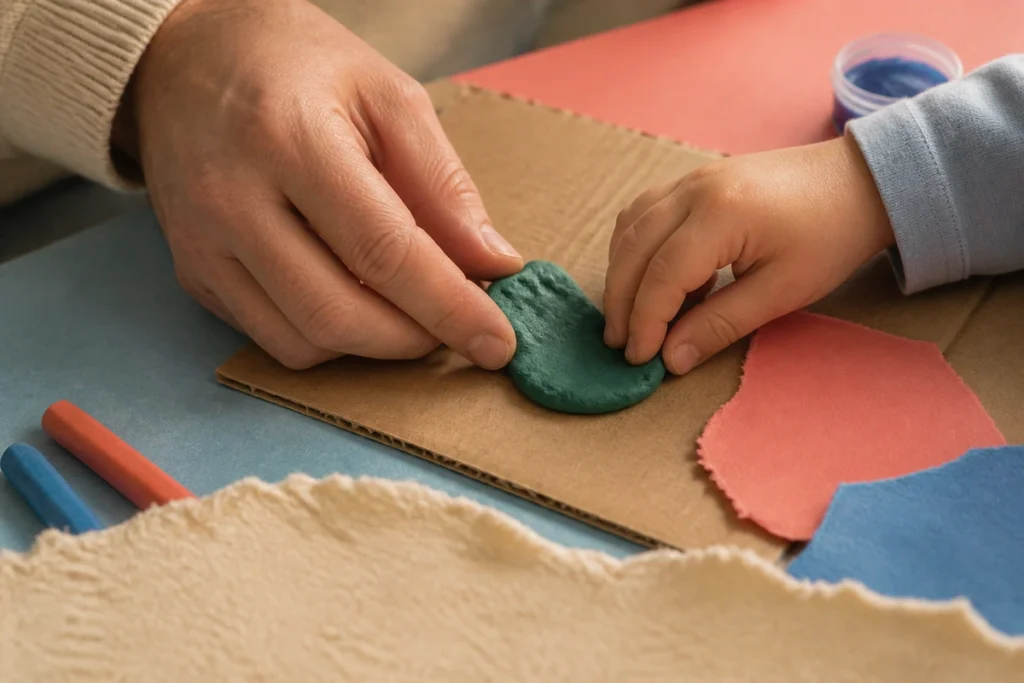
Setup: Age-appropriate play dough, a wipe-clean mat, and a few safe utensils. Make pretend buns, fruit, or tiny meals and take turns ordering. Preschoolers can roll and flatten shapes. Ages 6–7 can create a menu or combine pieces to match an order. Keep play dough separate from real food and follow its label.
13. Create a paper collage
Setup: Scrap paper, a larger base sheet, and child-appropriate glue. Pre-cut shapes for younger preschoolers; children ready to cut can use child-safe scissors with close adult guidance. Arrange the pieces before gluing or build a picture as you go. Older children can work from a theme such as a garden, town, or funny creature.
14. Paint with a sponge
Setup: Washable, non-toxic paint, paper, a small sponge, and a covered surface. Dab circles, paths, patterns, or a simple background. Preschoolers can explore repeated marks; older children can layer shapes into a picture. Use a small amount of paint, protect clothing, and supervise so the materials are used as intended.
15. Fold simple paper creations
Setup: Square or rectangular paper and a flat surface. Make a simple fan, folded card, or basic paper hat instead of attempting a complicated model. Preschoolers can press folds made with an adult. Ages 6–7 can follow a short sequence and decorate the result. Adult help matters more than perfectly sharp folds.
If you would like a ready-made option alongside these open-ended ideas, browse our preschool printables.
Active indoor ideas for energetic moments
Clear the play area first, then keep the rules simple and the pace comfortable.
16. Follow a painter’s-tape line
Setup: Low-tack painter’s tape on a suitable floor. Make one straight, curved, or zigzag path. Children can walk heel-to-toe, step beside the line, or carry a soft toy along it. Older children can design a second route. Test the tape on the surface first and remove it after play.
17. Hold an animal-movement relay
Setup: A clear route between two visible points. Walk like a bear, waddle like a penguin, or stretch tall like a giraffe. Preschoolers can copy one movement at a time. Ages 6–7 can choose the next animal or combine two movements. Avoid speed if the space is small, slippery, or shared.
18. Toss rolled socks into a basket
Setup: Clean rolled socks and a laundry basket on the floor. Begin close to the basket and move the starting point only if the game remains comfortable. Preschoolers can count successful tosses together. Older children can choose different scoring zones. Use soft socks, keep throws below head height, and stay away from breakable objects.
19. Play stop-and-go dance
Setup: A clear space; music is optional because clapping or humming works too. Move while the leader makes a sound, then freeze when it stops. Preschoolers can practise one rule. Ages 6–7 can add slow, fast, high, or low movement prompts. Keep the pace manageable and skip movements that do not suit the space.
20. Plan a living-room scavenger hunt
Setup: A short spoken or drawn list of safe objects already in view. Ask for something soft, something square, or something used at breakfast rather than hiding tiny items. Preschoolers can find one object at a time. Older children can solve descriptive clues. Set clear boundaries so cupboards, stairs, and private spaces stay out of the hunt.
Outdoor and fresh-air screen-free activities
Stay together and adapt these ideas to the weather, location, and your child’s supervision needs.
21. Go on a nature color hunt
Setup: Optional paper with several color marks. Look for leaves, flowers, stones, or signs that match each color without needing to collect them. Preschoolers can point and name; ages 6–7 can notice different shades or photograph nothing and describe their finds later. Leave plants and wildlife as you found them.
22. Draw a sidewalk or pavement chalk trail
Setup: Washable outdoor chalk and a permitted hard surface away from traffic. Draw a line with circles, arrows, and stopping points to follow. Preschoolers can step from mark to mark. Older children can design a route for someone else. Check the surface, local rules, and weather, then wash hands after using the chalk.
23. Make a garden or backyard obstacle course
Setup: Safe, stable objects such as chalk marks, a hoop, or an empty box. Create three simple actions: walk around, step over a low line, and reach a finish point. Preschoolers can repeat the same route. Ages 6–7 can rearrange it. An adult should inspect every item and supervise the course throughout.
24. Tell stories about the clouds
Setup: A comfortable place to sit or lie outdoors, with suitable sun protection for the conditions. Take turns describing a cloud shape and what it might become next. Preschoolers can name familiar objects. Older children can link several shapes into a story. Remind children to look at clouds rather than directly at the sun.
25. Arrange leaf-and-stick patterns
Setup: Fallen natural items from a familiar, suitable area. Arrange a repeating line, face, spiral, or tiny landscape on the ground. Preschoolers can sort by size or color. Ages 6–7 can make a repeating pattern for someone else to continue. Supervision: Check items before handling and skip unknown plants, sharp pieces, and anything a child may mouth.

How to adapt the activities for ages 3–7
Keep preschoolers central with short explanations, visible choices, and one step at a time. For ages 3–4, demonstrate the first action and accept pointing, copying, or a one-word answer. For ages 4–5, invite a choice of color, character, route, or role.
For ages 6–7, add an optional extension such as labels, clues, a sequence, simple scoring, or a child-created rule. These are choices, not standards a child must meet. Siblings can share materials while taking different roles.
Simple safety and supervision checks
Before starting, scan the space and materials from your child’s point of view. Follow age guidance on toys and craft products, including the CPSC toy-safety guidance. Skip unsuitable small pieces, use non-toxic materials as directed, keep adult tools with the adult, and help closely with cutting, active movement, and outdoor play.
“Low help” describes setup; it does not mean no supervision. Consider your child, other children, pets, stairs, flooring, and breakable objects. If an activity does not fit today’s space or energy, choose another.
Make screen-free ideas easier to repeat
Choose five reliable favorites: one no-prep idea, one quiet option, one creative activity, one movement game, and one outdoor choice. Keep the menu somewhere visible.
An activity may be brief, change direction, or become a different game. It does not need to look polished; it needs to fit your child, home, and available time.
For more ways to build a flexible rotation, browse more activity ideas.
Frequently asked questions
What are the easiest screen-free activities for preschoolers?
Try animal charades, I Spy, a shared story, copy-me movements, or a picture-book hunt. Give one clear instruction and join for the first turn.
How can I keep a preschooler busy without TV?
Offer two choices, such as a drawing activity or movement game. Rotate quiet, creative, pretend, and active options. This adds choices without judging a family’s usual screen use.
Which screen-free activities require no preparation?
I Spy, animal charades, story chains, copy-me movements, cloud stories, and simple scavenger hunts need little setup. Sock sorting and rolled-sock tossing use familiar objects. Check the area first.
Can preschoolers do screen-free activities independently?
Some children may continue a familiar activity with less direct help, but an adult still prepares the space, checks materials, and remains appropriately available. Decide from the individual child and situation, not a promised age or duration.
How can I adapt these activities for ages 3–7?
For preschoolers, model one step and offer visible choices. For ages 6–7, optionally add labels, clues, a longer sequence, or a child-created rule. Keep the preschool version central in mixed-age play.
Choose one easy activity and keep it simple
You do not need a packed schedule or many supplies. Choose one activity that matches today’s time, space, and patience, then adapt it as you go. A quick guessing game and a longer cardboard-box project can both make another kind of play easier to start.
Ready for Another Easy Screen-Free Idea?
Browse free printable activities you can use when you want a simple, ready-to-go option.


5 notes from other parents