
For this number matching game, put homemade cards face up and find three that show the same total: a numeral, a group of dots and dots split into two smaller groups. Count together to check, then ask what makes the cards a match. Below is a complete nine-card example using 3, 4 and 5.
You need paper and a marker, with an adult preparing the cards. There is no timer, score sheet or download to find. Start with one match and leave the rest for another day if that is enough.
A game for explaining numbers, not racing
A numeral is the written symbol, such as 5. A quantity is how many things there are. The interesting question here is whether your child can connect that symbol with pictures that look different but show the same quantity.
NRICH’s Matching Numbers activity, labeled for ages 5–7, explores different representations of a number. Its face-up option removes the need to remember where hidden cards are. Our small homemade set below uses that open-card approach, with a specific recipe you can draw yourself.
Use your child’s familiarity with the numbers to choose a starting point. You can read a numeral aloud or begin with two picture cards. The age range is a guide to the activity’s focus, not a deadline for being able to do it.
Make nine cards: three numbers, three ways
An adult can fold or cut a sheet into large rectangles. Make the cards the same size, use plain backs and draw every dot in the same color. Avoid giving all the cards for one number a matching border: that would let your child solve the game by color alone.
For each number, make these three kinds of card:
- A numeral card: write one large 3, 4 or 5.
- A dot card: draw that many clearly separated dots in a row.
- A split-group card: draw two little groups of dots, with a generous gap between them.
Here is the full recipe. The split-group cards contain dots, not written sums; the numbers in the last column tell the adult how many dots to draw.
| Numeral card | Dot card | Split-group card |
|---|---|---|
| 3 | 3 dots in a row | 1 dot, a gap, then 2 dots |
| 4 | 4 dots in a row | 2 dots, a gap, then 2 dots |
| 5 | 5 dots in a row | 2 dots, a gap, then 3 dots |
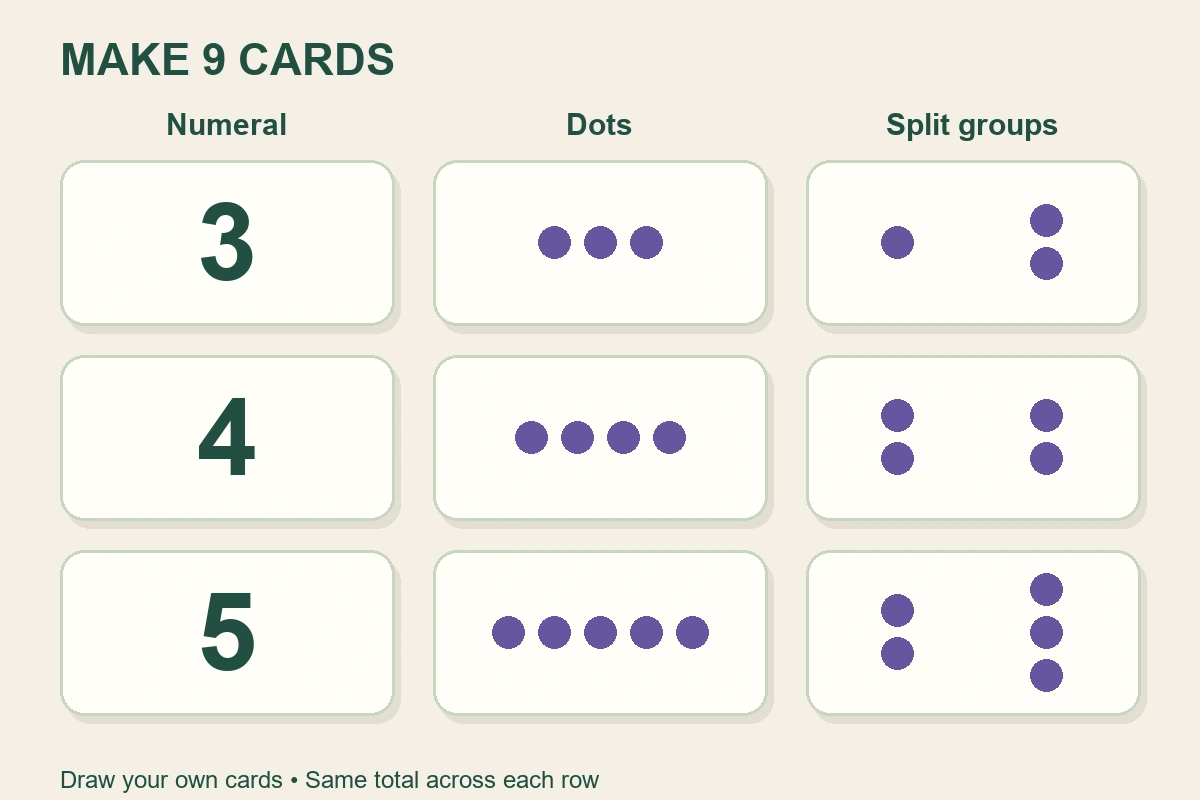
Count every card before play. Keep the dot sizes similar and leave enough space to point to each one. These are homemade activity examples, not pages from a KidsColorsBook product.
Play one match together
Begin with just the three cards for 5. Place the numeral beside the row of five dots. Read “five” and touch each dot once as you count. Then bring in the card with two dots on one side and three on the other.
Ask, “Does this card show five too? How could we check?” Your child can count all the dots, point as you count, or describe the two groups. You might say, “I see two here and three here. There are five altogether.” Written addition is not required.
NCETM’s guidance on number composition describes noticing smaller groups within a whole number. That is the idea behind this third card: the gap separates the parts, but it does not remove any dots from the total.
When that match feels clear, mix the nine cards face up. Invite your child to choose one card and find its two partners. Group the matches wherever there is space; this is not an ordered number line. Ask for an explanation before moving to another set.
Check a tricky match without giving the answer
Suppose your child puts the numeral 5 beside a card showing two dots and two dots. Leave the cards visible and ask, “Can we count this whole card together?” Touch all four dots, including those across the gap. Then compare it with the five-dot row.
You can redraw both totals in rows on scrap paper and point to one dot in each row together. Ask which card needs another dot to show five. The useful part is making the difference visible, not saying “wrong” and replacing the card for your child.
If your child counts only the larger group, sweep a finger around the whole card and say, “We are finding how many on this entire card.” If the dots are crowded, redraw them farther apart before trying again.
Make the game simpler—or change the challenge
- Nine cards feel busy: use only the sets for 3 and 4, or return to one three-card match.
- Numerals are unfamiliar: match a row of dots with a split-group card first. Add the numeral while saying its name.
- Moving cards is awkward: let your child point and move the chosen card for them.
- The matches are easy: ask your child to draw a new card for 5. Four dots and one dot would work. Check the total together before adding it to the game.
- Your child wants to lead: swap roles. They choose a card and ask you to explain your match.
Change one thing at a time. Larger numbers, hidden cards and written sums each add a different task; you do not need all three to make this game worthwhile.
Do you need a printable?
No. The recipe above is enough to make the game. If you already own number cards, check their actual pictures before using them: a numeral-only set will not supply the dot and split-group examples.
For a seasonal activity focused on counting objects, see our Halloween counting activities. For a different early-math idea, our AB pattern activities explore a repeating pair. You can also browse the KidsColorsBook activity guides to choose what suits your next play session.
Number matching questions
Do the dots have to look the same to match?
No. Cards match in this game when they show the same total. A row of five dots and a group of two beside a group of three both show five, even though their layouts differ.
Should the cards be face down?
Keep them face up while the goal is explaining equal quantities. Turning them over adds a memory task. You can try that separately, but it is not needed for this version.
Does my child need to know addition facts?
No. Your child can count every dot on a split-group card. Noticing the smaller groups offers another way to describe the same total; there is no need to recite a fact or write an equation.