
For a Halloween scavenger hunt for preschoolers, place a few large Halloween pictures around one room and give your child a matching picture list. Show one picture, look for its match together, then mark it as found. Use friendly pumpkins, cats or stars, keep every picture in an easy-to-see place, and let your child point instead of reading or writing.
You can make this indoor hunt with paper and a crayon. There are no riddles to solve, treats to hide or special decorations to buy. The fun is noticing a familiar picture somewhere new: a pumpkin beside the books, or a smiling moon on a chair back.
The example below uses six pictures. Start with two or three if that suits your child today, then add more only if they want another round. The number of pictures is a setup choice, not a test of what a child should manage at a particular age.
Set up your Halloween picture hunt
Choose one familiar room where you can stay together. Clear the walking space, and decide which places belong to the game before setting out any pictures. A small living-room area is enough. You do not need to use the whole house.
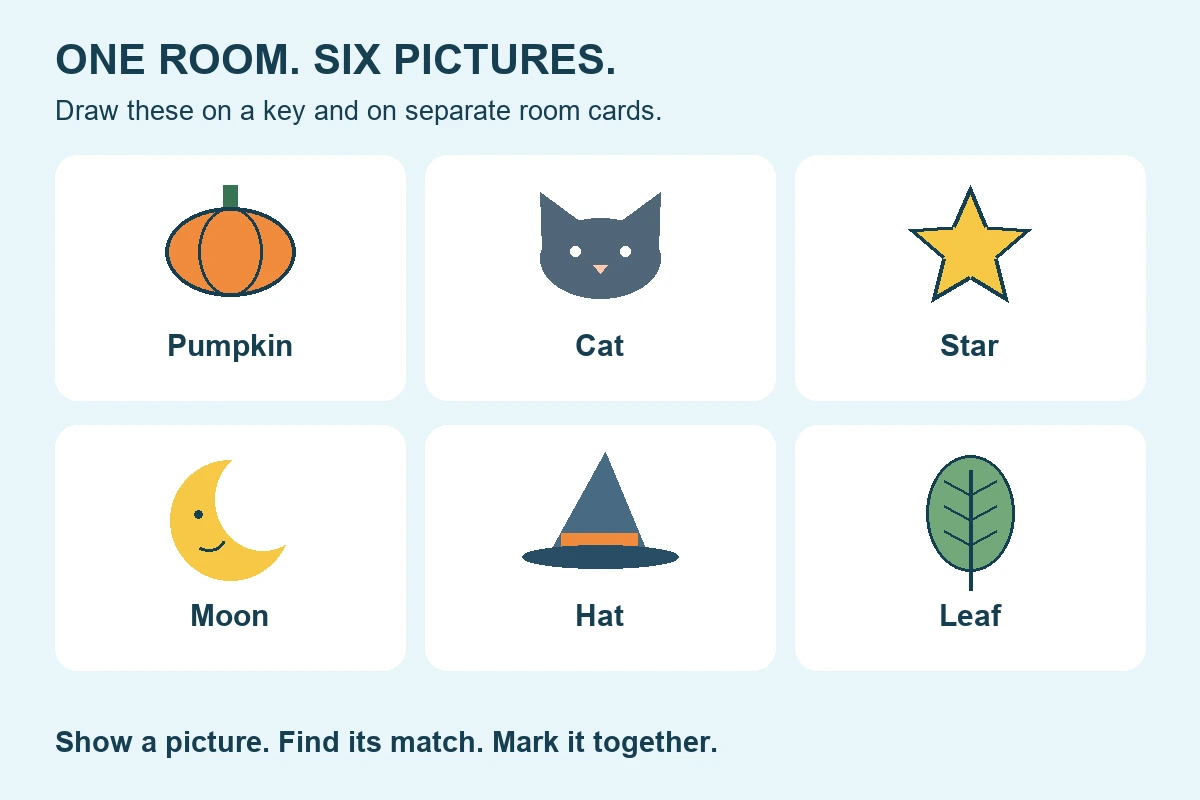
Gather plain paper, a dark crayon or marker, and a little removable tape suitable for the surfaces you will use. Have an adult prepare any cut pieces. Draw one large, simple picture on each card, then draw smaller versions together on a separate sheet. This second sheet is your picture key: it shows what players are looking for.
Drawing is optional. You can use matching pictures you already have permission to print, but make sure the key and the room cards show the same recognizable images. Different-looking cats can make the first round needlessly confusing. Keep a homemade set simple enough that you can draw each picture twice.
Put the cards in plain sight at a height your child can comfortably see. Tape them to vertical surfaces rather than leaving loose paper in the walking route. Check that your tape stays put and remove it after play. Tell your child: “We are looking for our paper pictures in this room. We don’t need to open anything or climb.”
Six pictures for a one-room hunt
Use the following as a ready-to-copy plan, changing the positions to fit your room. Each picture appears once on the key and once around the room. The spoken hints are optional; show the picture first and give your child time to look.
| Picture to draw | Example position | A small spoken hint |
|---|---|---|
| Pumpkin: a round shape with a stem | On the front of a low bookcase | “Look near our books.” |
| Cat: a face with two pointed ears | On the outside of a toy-storage box | “Look beside the toys.” |
| Star: one large star shape | On a clear patch of wall | “Look on this wall.” |
| Moon: a smiling crescent | On the back of a stable chair | “Look where someone can sit.” |
| Hat: a pointed hat with a wide brim | On a low, visible cabinet front | “Look at the front, without opening it.” |
| Leaf: a broad leaf with a middle line | On another clear wall section | “Look near the edge of our play space.” |
If your child dislikes Halloween characters, keep the pumpkin, star, moon and leaf, and leave out anything they find unsettling. A seasonal hunt can use cheerful shapes without costumes, darkness or spooky sounds.
How to play without reading
Show one match first. Hold the key where you can both see it. Point to the pumpkin, name it, then walk together to its matching card. Say, “Pumpkin here, pumpkin on our list.” Leave the room card in place, especially if other children will also look for it.
Let your child choose the next picture. They can point to a shape on the key or tell you its name. Look together without adding another instruction straight away. If they find a different card first, that counts too: return to the key and find its matching picture.
Record the find in a way that works for you. Your child can make a crayon mark beside the picture, ask you to mark it, or simply point while you say which ones remain. You do not need stickers, counters or written words. For a first round, an adult can hold the key so the child has less to carry.
Finish when your chosen pictures are found, or earlier if play is over. Look back at the key together: “We found the cat and the star.” Invite your child to choose a favorite. There is no need to count a score or find every card before stopping.
For another round, change only one thing. Move the pumpkin to a different visible spot, or add the leaf. Keeping the same pictures gives your child a familiar starting point while the search changes.
Adjust the hunt for your child or group
For a shorter first hunt: set out two cards near each other and show only those two pictures on the key. Walk with your child and model pointing to a match. Add another card on a later round if they ask to keep going.
For children who want more challenge: spread the pictures farther apart within the agreed room, or let them create the next key. An older child can invent a short spoken hint. Keep the picture available, so reading never becomes the only way to join in.
For siblings or a small group: use one shared key and take turns choosing the next target. One child might hold the sheet while another points out the card. Rotate those jobs. Treat each find as a group discovery rather than a race to collect the most pictures.
For a seated version: place the pictures on a nearby board or across one clearly visible wall area. Your child can search with their eyes and point, while you bring the key closer. Arrange the cards for their comfortable view, and let them direct you if they want a picture moved.
If your group would rather stay at a table, our Halloween Bingo guide for preschoolers explains another way to play with pictures before reading.
When the hunt gets stuck
“I can’t find it.” Bring the key close to the matching area and offer a smaller search: “Shall we look at this wall together?” Point toward the area if needed. Move a card into a clearer position when the hunt has become frustrating.
Everything gets found at once. That can be a complete, happy round. Ask whether your child wants to help you move two pictures. You do not need to hide cards inside containers to make the next round worthwhile.
The pictures get collected. Pause and show the rule again: find, point, leave in place. If collecting is the part your child enjoys, you could instead make a small tabletop matching game with a few loose cards and the key, while you play together.
One child finds every picture first. Give each player a turn choosing a target, or ask the quicker finder to offer one hint. Avoid assigning a child the same helper role throughout; everyone can have a turn searching.
Keep the search gentle and contained
Stay with preschoolers during the hunt. Keep the game in your agreed area, with no climbing, opening drawers or reaching behind furniture. Use paper pictures as targets, leaving candles, electrical decorations, breakables and small decorative pieces outside the activity.
The American Academy of Pediatrics’ Halloween safety guidance advises removing trip hazards and keeping candlelit pumpkins away from routes people pass. For this indoor version, use an ordinary well-lit room and clear the path between pictures before you begin.
A costume is optional. If your child wears one, check that it does not trail underfoot or obstruct their view. The same AAP guidance recommends well-fitting costumes and keeping hats from covering children’s eyes. Stop or change the game if a character, sound or part of the setup bothers your child.
Want a printable option?
Homemade pictures are enough for this hunt. If you already use printable activities, check the page before setting it out: does your child recognize the pictures, and can you find suitable matches within your chosen room? An adult can read any written instructions aloud.
For help getting an existing PDF onto paper, use our A4 and US Letter printing guide. You can also browse KCB’s free printable activities for a different activity; that collection is not a promise of a matching scavenger-hunt download.
Frequently asked questions
How do you do a Halloween scavenger hunt with children who cannot read?
Use a picture key and matching pictures around the room. Demonstrate one match, then let children point, name the picture or ask you to mark it as found. Spoken hints are optional. Avoid written riddles as the only route to the next item.
How many pictures should I use?
Try two or three for a small first round, or use the six-picture example if your child wants a longer search. There is no required number. Reduce the set when it feels like too much, and add pictures only while everyone wants to continue.
Do I need to hide sweets or buy decorations?
No. Draw your pictures on paper and place them in visible spots. Finding the pictures is the activity. You can finish with choosing a favorite picture or helping to take down the cards, with no prize or extra purchase.
Can I run the hunt in a small room?
Yes. Use a few visible cards on suitable wall or furniture fronts within one clear area. For less movement, arrange them on a board and search from a seat. Keep the picture key close enough to compare with each find.
Start with the room and paper you already have, demonstrate one match, and let the next find set the pace. For a different seasonal activity afterward, explore our not-too-spooky Halloween activity ideas.