

You set out five pumpkins. Your child says “one, two, three, four, five, six!” while pointing back to a pumpkin they already counted. Instead of adding more numbers, change the setup: give the pumpkins somewhere to go after each count.
The five ideas below use that same small collection in different ways. Choose one that fits today, play together and leave the rest for another time. These are activity suggestions, not an age test or a course your child needs to finish.
For crafts, movement games and pretend play beyond counting, browse our gentle Halloween activities for preschoolers.
Start with a small group and one clear job
Draw a few friendly pumpkins on separate large cards, or have an adult prepare broad paper shapes. Use plain circles if you would rather skip the Halloween theme. Keep the pieces similar so there is less to discuss before the counting starts. Two sheets of paper can become a pumpkin patch and a delivery area.
Begin with three pieces as a trial, then reduce or increase the set to suit the child. That starting number is a suggestion, not a milestone. NAEYC describes counting objects one by one and understanding that the last number tells the total as distinct early number skills; it also notes that children develop these skills at different rates. See its guidance on early number play.
Keep materials suitable for everyone nearby. Use large paper pictures instead of beads, coins or tiny Halloween decorations. Follow toy and art-supply age labels, supervise the activity and have an adult handle cutting. Small parts pose a choking risk, particularly for children under three; the CPSC explains the small-parts hazard. If a child mouths materials, use a single sheet with pictures to point to and keep loose pieces out of reach.
Try this short demonstration: move one pumpkin and say “one,” move the next and say “two,” then move the last and say “three.” Sweep your hand beside the finished group: “Three pumpkins altogether.” Give your child a turn with the same set before changing anything.

Five Halloween counting activities to try
Each activity has one main job. The easier option changes the task; the extension is there only when your child wants another challenge. Let them answer by pointing, moving or speaking, and use the number words your family normally uses.
1. Pumpkin move-and-count
Set out: A few paper pumpkins and two plain sheets. Put all the pumpkins on the first sheet and leave the second empty.
Play: Call the empty sheet the pumpkin patch. Invite your child to move one pumpkin into it for each number they say. Keep a visible gap between the starting pile and the finished group. When the first sheet is empty, ask, “How many made it to the patch?” Count together again if they want to check.
Parent prompt: “This pumpkin has arrived. Which one is still waiting?” The separate spaces give you something concrete to point to if a pumpkin gets counted twice.
Make it easier: Offer two pumpkins and take turns moving one each. Try next: Let your child deliver the same group back while you count. They can be the checker and stop you if you miss a pumpkin.
2. One ghost for each window
Set out: A sheet with three large windows drawn on it and three big paper ghost pictures. Simple white ovals with friendly faces are enough; an adult can prepare them.
Play: Put one ghost in each window. Count the ghosts after everyone has a place. Ask, “Does every window have a ghost?” Keep this as a matching task first: there is no need to introduce written numbers at the same time.
Parent prompt: “That window has one already. Where is an empty window?” If two ghosts move into one window, let your child look for a space that still needs one.
Make it easier: Draw two windows, spaced well apart. Try next: Offer one more ghost than there are windows and ask what happened. Your child might notice the spare ghost, count the groups or suggest drawing another window.
3. Build a pumpkin order
Set out: Your pumpkin cards, a delivery sheet and an adult-drawn order card showing two or three large dots.
Play: Pretend you are ordering pumpkins for a doorstep. Say, “My order has three dots. Can you bring me that many pumpkins?” Your child can place a pumpkin beside each dot, then move the order onto the delivery sheet. Count the delivered pumpkins together before taking a new order.
Parent prompt: “Let’s check the order before we deliver it.” If your child brings the whole pile, return to matching one pumpkin to each dot.
Make it easier: Show a matching group of pumpkins instead of a dot card. Try next: Add a written numeral beside the dots and name it. Keep the dots available; identifying a written number does not need to become the entry requirement for the game.
4. Count, cover and check
Set out: A small group of pumpkins and a plain sheet large enough to hide them.
Play: Count the group together, then cover it without adding or removing anything. Ask, “How many pumpkins are resting underneath?” Lift the sheet to check whenever your child wants. If they prefer to do the covering, you can answer and let them reveal the group.
Parent prompt: “We counted three, and none went away. Shall we look?” Keep the exchange playful rather than demanding a remembered answer.
Make it easier: Leave the whole group visible and simply ask how many there are. Try next: Have your child choose a small set, count it with you and invite another person to check. Skip hidden-object variations if they make the activity frustrating.
5. Same pumpkins, new arrangement
Set out: Three or four pumpkin cards with space to spread them out.
Play: Count them in a row. While your child watches, move the same pumpkins into a circle or spread the row farther apart. Ask, “We moved them. Did any arrive or leave?” Count again together to check the total.
Parent prompt: “The row is longer now. Let’s find out how many pumpkins are in it.” Accept a guess, then use the objects to investigate it. Avoid making the question sound like a trick.
Make it easier: Keep two pumpkins on a single sheet and move them only a little. Try next: Invite your child to design a new arrangement while keeping the same group. This can become a tiny pumpkin display, with counting as the final check.
When counting goes off track
Change one thing before repeating the task. A smaller group, more space or a turn watching you may give you a clearer next step than another instruction to “count carefully.”
| What you notice | Try this next |
|---|---|
| The same picture gets counted twice. | Move counted pieces to a second sheet, leaving a clear gap. |
| Number words run ahead of the pointing. | Model one slow move with one number word. Try a smaller group. |
| A picture gets skipped in a busy group. | Spread the pictures into a simple row, or cover the unused part of a page. |
| The child counts objects but does not recognize the numeral. | Keep counting with objects or dots. Name the numeral yourself if you use it. |
| The child wants to tell a pumpkin story instead. | Join the story, offer one small counting moment or put counting aside. |
These observations help you adjust this activity; they do not diagnose a learning problem. If you have broader concerns about your child’s development, discuss what you have noticed with their teacher or health professional.
Choosing a Halloween counting worksheet
A printed page is an optional change of format. Look at one group of pictures before handing over the whole page. Can your child find where to start? Can they point to each picture clearly? Read any directions aloud and separate the counting from writing an answer.
For example, let your child count a group orally while you record the total. Or cover the other rows with a plain sheet and work on one row together. Completing every box is not needed for a useful counting turn.
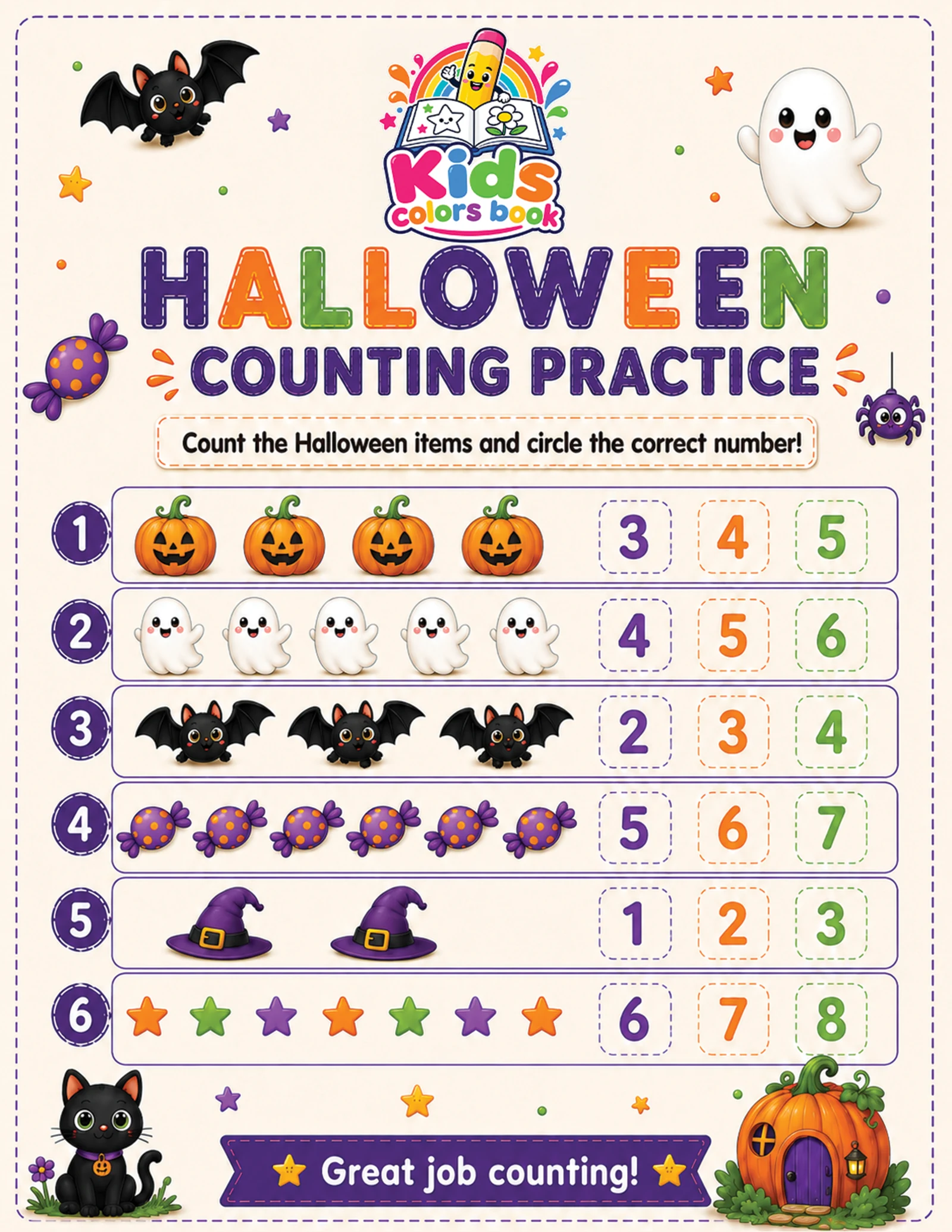
The KidsColorsBook Halloween Learning Worksheets – 17 Printable Activities pack includes Counting Practice, I Spy & Count and Count & Graph alongside other activities. It is listed for ages 3–8, in ZIP/PDF printable format for US Letter paper. Selected answer keys come as a separate download. Preview the pages and choose a suitable task; the age range does not mean every page fits every child.
Your homemade pumpkin cards are enough for all five activities above. If you want a different creative starting point, you can preview the free printable offer; that page asks for an email signup and is not a download of these Halloween counting activities.
Frequently asked questions
What is an easy Halloween counting activity for a preschooler?
Move a few large paper pumpkins from one sheet to another, saying one number as each pumpkin moves. At the end, say how many arrived. Use two or three pieces for a first try and adjust the group to the child.
Does my child need to write numbers before trying these games?
No writing is required here. Your child can move pictures, point to dots or tell you the total. If you introduce an order card with a numeral, read it aloud and keep a matching set of dots beside it.
What if my child counts the same pumpkin twice?
Give counted pumpkins a separate place to go. Move them away from the starting group and leave them there until the count ends. Demonstrate with fewer pieces before asking your child to try again.
Can I use these ideas without Halloween printables?
Yes. Draw circles on large cards, use suitable familiar toys or point to pictures on one sheet. The five activities are homemade play ideas. No purchased pack or special Halloween download is required.
Put one small set within reach and choose a single game. If your child wants another turn, reuse the pieces. For another day, explore our other screen-free activity ideas.


1 note from other parents