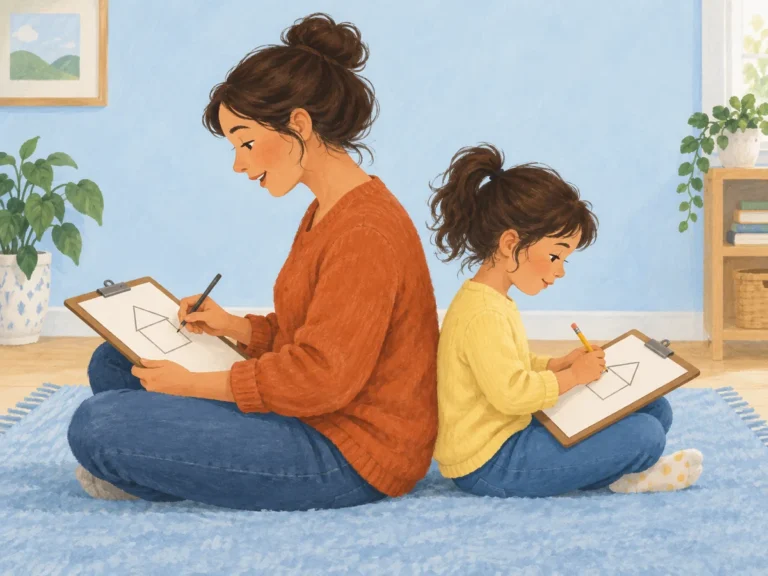
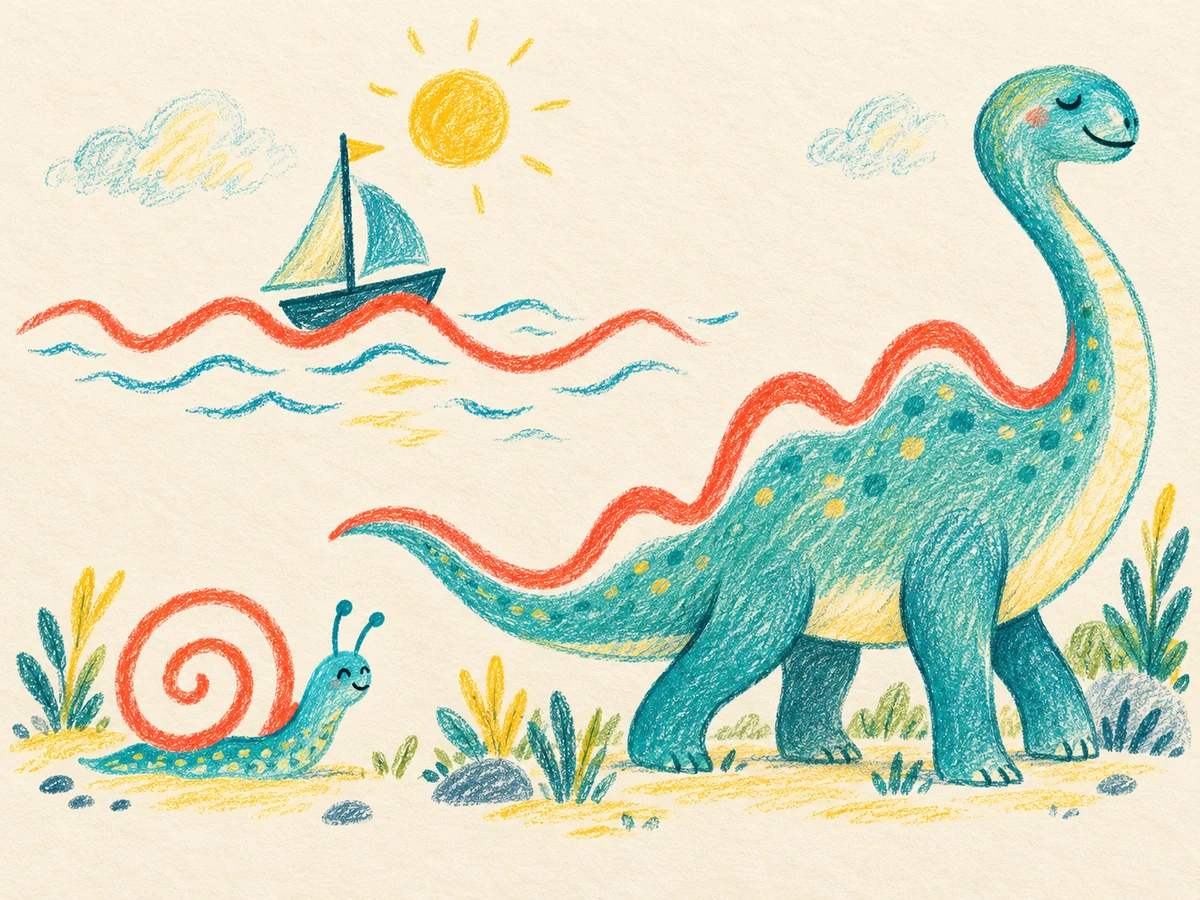
A squiggle drawing game for kids starts with one loose line: you draw a mark on blank paper, your child turns it into a picture, then you swap roles. Keep the starting line visible, but let it become anything. There is no hidden picture to guess and no correct answer.
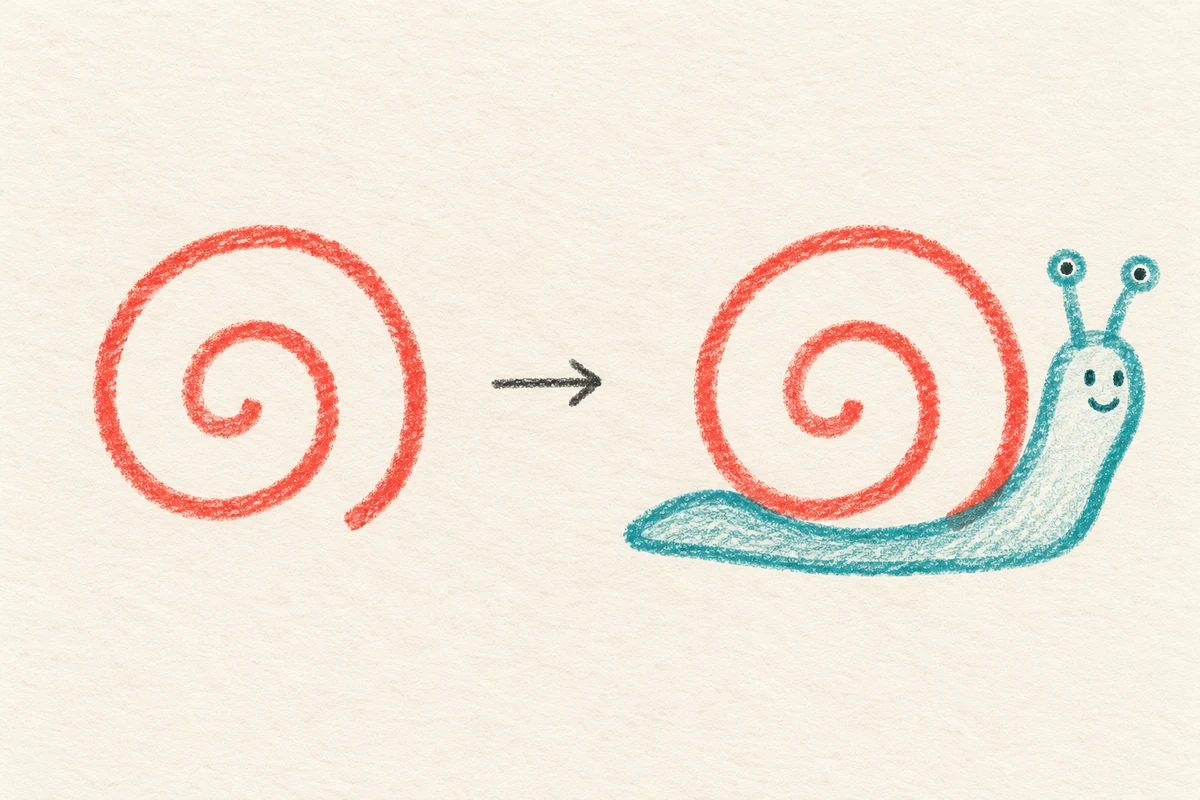
A loop might become a snail shell. Turn the paper, and the same loop could become a balloon. Your job is to offer a starting point and leave room for your child’s idea.
What you need
- Blank paper, with room around the starting mark.
- Two different-colored pencils, crayons or washable markers: one for the squiggle and one for the additions.
- A firm drawing surface and a place to put finished pictures.
Two colors make the original line easy to spot, but one pencil works too. Skip the template, timer and scoring sheet for the first round. A small, open squiggle gives your child more room than a dense scribble filling the page.
How to play the squiggle drawing game
- Make a starter mark. Draw one curve, loop, wave or zigzag. Stop before it looks like a finished object. Leave plenty of blank space on every side.
- Hand over the paper. Ask, “What could this become?” Let your child rotate the sheet and look before drawing. Avoid announcing the picture you had in mind.
- Add to the line. Your child adds details around or connected to the mark. The squiggle stays part of the finished picture; it can be an outline, a small detail or something in the background.
- Invite a reveal. Ask, “Tell me about your picture.” Accept the explanation even if you would have interpreted the lines differently. A name or short story is optional.
- Swap roles. Your child makes a new mark for you. Draw your own idea, then decide together whether to play another round or finish.
Try one round: draw a loose loop in one color. If your child chooses a snail, they can add a body underneath, feelers and a trail with the second color. If they choose a balloon instead, they can add a string. Both use the same starting mark successfully.
The basic make-a-squiggle, transform-it and swap-turns format also appears in Quadring Primary School’s squiggle game. The examples below are starting ideas for your own round, not pictures children need to reproduce.
Five easy starter marks and what they could become
Offer one mark at a time. Keep these suggestions to yourself initially, so your child has the first chance to imagine something.
1. A loose loop
Try a snail shell, a balloon or the body of an imaginary creature. Keep the loop off-center so there is room for a head, string or tail. It does not need to be a perfect circle.
2. A shallow wave
The wave could become water under a boat, a snake’s back or a windy path. Your child can add most of the picture above the line, below it or at one end.
3. A short zigzag
Three or four bends might suggest mountain peaks, a crown or a creature’s spiky back. Leave the ends open; joining them is one possible choice, not a rule.
4. A hook-shaped curve
A bent line could become an elephant’s trunk, an umbrella handle or a curled tail. If your child sees a tiny detail, encourage them to use the space around it for the larger picture.
5. A wide arch
An upside-down U might become a bridge, a doorway or a hill. Rotate it sideways and it could be a mouth. The paper’s first orientation does not decide the answer.
When your child cannot see a picture yet
“I don’t know what it is.” Turn the paper together. Ask whether the line looks like a whole object or just one part. If that does not help, offer two possibilities: “Could it be something in the sea or something in the sky?” Leave the final choice open.
The squiggle feels too complicated. Start again with a shorter, more open mark. Several crossing lines can make the starting point harder to use. You can keep the first page for a later round.
Your child has an idea but wants you to draw it. Let them direct a shared picture: “Where should the tail go?” You can add the requested part while they choose details, make marks or tell you what comes next. Taking turns need not mean equal amounts of drawing.
They think their picture is wrong. Point out how they used the original line. Say, “You made the curve into a wing,” rather than correcting the drawing to match your own idea. If they dislike it, offer another sheet without making them finish.
Make the next round different
Same mark, different pictures: draw roughly the same starter on two sheets. Each of you completes one, then compare what you noticed. The marks do not need to match exactly, and the pictures do not compete.
Let the child set the challenge: they choose both the line and a broad setting, such as “under the sea.” Keep the setting optional if it makes finding an idea harder.
For siblings who want different levels of help, use the shared-role ideas in screen-free activities for siblings of different ages. A finished animal drawing can also become the starting point for an animal storytelling activity.
If your child wants a game with a picture to match, try the listen-and-draw game next. That activity uses spoken instructions to recreate a picture; this one invites different interpretations of a visible line.
Squiggle drawing game questions
Can we play without printing anything?
Yes. Blank paper and a pencil are enough. You make a fresh starter mark each round, so no worksheet or downloadable pack is needed.
Can my child play alone?
Yes. They can make a loose mark, pause, turn the sheet and add a picture. Another option is for you to leave a few separate starter marks on paper and let them choose one. Join in if they ask for help or want to show you what they made.
Start with one curve and see what it becomes. When drawing has run its course, choose a different kind of play from these screen-free activity ideas.